Go Back

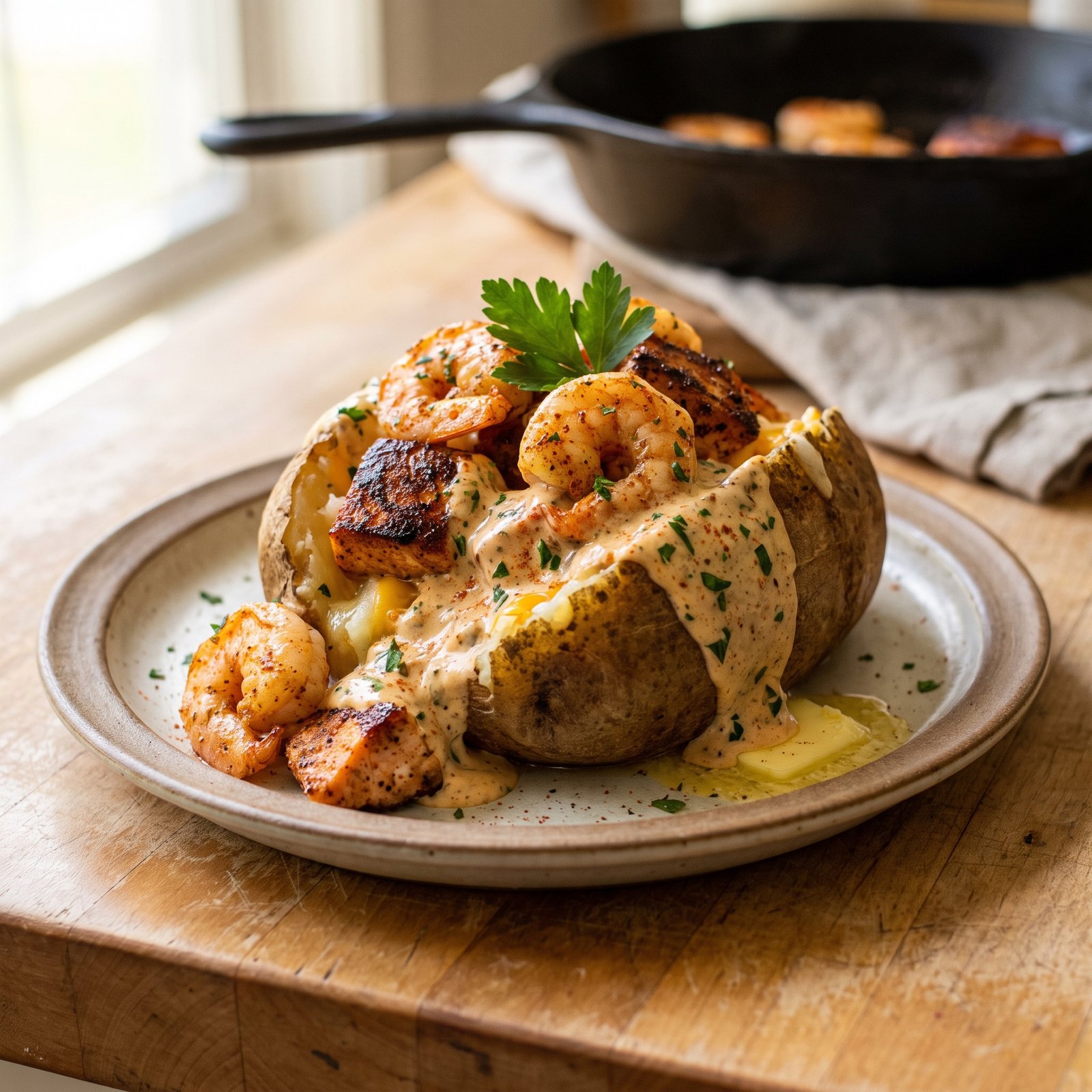
Creamy Cajun Salmon and Shrimp Baked Potatoes

Fluffy oven-baked potatoes piled high with Cajun-seasoned salmon, juicy shrimp, and a rich creamy garlic Parmesan sauce. A satisfying seafood dinner with bold Southern-inspired flavors.
Prep Time 20 minutes
Cook Time 1 hour
Total Time 1 hour 20 minutes
Servings: 4
Course: Main Course
Cuisine: American
Calories: 900

Ingredients
  

For the baked potatoes
  • - 4 large russet potatoes approximately 10–12 oz (280–340 g) each
  • - 1 tablespoon 15 ml olive oil
  • - ½ teaspoon kosher salt
  • - 2 tablespoons 28 g unsalted butter, for fluffing the potato centers
For the homemade Cajun seasoning
  • - 2 teaspoons smoked paprika
  • - 1 teaspoon garlic powder
  • - 1 teaspoon onion powder
  • - ½ teaspoon dried thyme
  • - ½ teaspoon dried oregano
  • - ½ teaspoon freshly ground black pepper
  • - ¼ teaspoon cayenne pepper or to taste
  • - ½ teaspoon kosher salt
For the salmon and shrimp
  • - 1 lb 450 g skinless salmon fillets, cut into 1½-inch (4 cm) pieces
  • - ¾ lb 340 g large shrimp, peeled and deveined
  • - 1 tablespoon 15 ml olive oil
  • - 1 tablespoon 14 g unsalted butter
For the creamy Cajun garlic Parmesan sauce
  • - 2 tablespoons 28 g unsalted butter
  • - 4 cloves garlic minced
  • - ½ cup 120 ml low-sodium chicken or seafood broth
  • - 1 cup 240 ml heavy cream
  • - ½ cup 55 g freshly grated Parmesan cheese
  • - 1 teaspoon lemon juice
  • - ½ teaspoon Cajun seasoning from the prepared blend reserved before seasoning the seafood
  • - Salt and pepper to taste
For garnish
  • - 2 tablespoons chopped fresh parsley
  • - 1 green onion thinly sliced, optional
  • - Lemon wedges for serving

Equipment

  • Large rimmed baking sheet
  • Fork for piercing potatoes
  • Large nonstick or stainless-steel skillet
  • Small mixing bowl
  • Tongs or fish spatula
  • Whisk
  • Sharp knife and cutting board
  • Instant-read food thermometer
  • Measuring cups and spoons

Method
 

Step 1 — Prepare and bake the potatoes
  1. Preheat the oven to 425°F (220°C).
  2. Scrub the russet potatoes thoroughly and pat them completely dry. Pierce each potato 5–6 times with a fork.
  3. Rub the skins with olive oil and sprinkle with kosher salt.
  4. Place directly on an oven rack with a baking sheet underneath to catch any drips, or arrange on a rimmed baking sheet.
  5. Bake for approximately 50–65 minutes, depending on size, until the skins are crisp and the centers are completely tender when pierced with a knife.
Step 2 — Mix the Cajun seasoning
  1. In a small bowl, combine smoked paprika, garlic powder, onion powder, dried thyme, oregano, black pepper, cayenne, and salt.
  2. Reserve ½ teaspoon of the mixture for the cream sauce.
  3. Pat the salmon pieces and shrimp dry with paper towels. Sprinkle the remaining Cajun seasoning over both, turning gently to coat evenly.
  4. Set aside while heating the skillet.
Step 3 — Sear the Cajun salmon
  1. Heat the olive oil and 1 tablespoon butter in a large skillet over medium-high heat.
  2. Add the seasoned salmon pieces in a single layer, leaving a little space between them.
  3. Sear for approximately 2–3 minutes per side, turning carefully, until golden and the thickest pieces reach 145°F (63°C).
  4. Transfer the salmon to a clean plate and keep warm. Avoid overcooking, as the salmon will continue to warm when the sauce is added.
Step 4 — Cook the shrimp
  1. Add the shrimp to the same skillet.
  2. Cook for approximately 1–2 minutes per side, depending on their size, until the shrimp turn pink, opaque, and firm.
  3. Avoid overcrowding the pan, and work in batches if necessary.
  4. Transfer the cooked shrimp to the plate with the salmon. Do not leave the shrimp in the hot skillet while making the sauce, or they may become rubbery.
Step 5 — Make the creamy Cajun sauce
  1. Reduce the skillet heat to medium-low. Add the remaining 2 tablespoons butter.
  2. Stir in the minced garlic and cook for 30 seconds until fragrant.
  3. Pour in the broth, scraping the bottom of the skillet to loosen the flavorful browned bits.
  4. Add the heavy cream and reserved Cajun seasoning. Bring to a gentle simmer and cook for approximately 3–4 minutes.
  5. Reduce the heat to low and gradually stir in the grated Parmesan until the sauce becomes smooth and lightly thickened.
  6. Add lemon juice and taste before adjusting salt or pepper. Avoid boiling the sauce after adding the cheese.
Step 6 — Combine the seafood with the sauce
  1. Return the cooked salmon and shrimp to the skillet.
  2. Gently fold them into the creamy Cajun sauce, taking care not to break the salmon into very small pieces.
  3. Warm over low heat for approximately 1 minute, just until everything is heated through.
  4. If the sauce becomes too thick, add a small splash of broth.
Step 7 — Open and fluff the potatoes
  1. Remove the baked potatoes from the oven.
  2. Carefully slice each potato lengthwise without cutting all the way through.
  3. Gently squeeze the ends to open the centers, then fluff the flesh with a fork.
  4. Divide the 2 tablespoons butter among the four potatoes and mix lightly into the fluffy interiors.
Step 8 — Load and serve
  1. Place each potato on a serving plate.
  2. Spoon a generous portion of Cajun salmon and shrimp over the center of each potato, dividing the seafood evenly.
  3. Drizzle with additional creamy Cajun sauce, then finish with fresh parsley and optional green onion.
  4. Serve immediately with lemon wedges on the side.
  5. Success Tips

    -Choose similarly sized potatoes. This helps all four potatoes finish baking at approximately the same time.
    -Dry the potato skins thoroughly. Moisture on the surface prevents the skins from becoming crisp.
    -Use fresh or properly thawed seafood. If using frozen salmon or shrimp, thaw in the refrigerator and pat dry before seasoning.
    -Don't overcrowd the skillet. Seafood needs direct contact with the hot surface to develop a flavorful crust.
    -Cook salmon and shrimp separately. They have different cooking times, and separating them helps prevent overcooking.
    -Grate Parmesan fresh. It melts more smoothly into the cream sauce.
    -Keep the sauce at a gentle simmer. High heat can cause the cream and cheese to separate.
    -Add lemon at the end. A little acidity brightens the rich sauce without overwhelming the seafood.
    -Serve immediately. Freshly baked potatoes and just-cooked seafood have the best texture.

    Storage and Reheating

    -Refrigerator: Store the seafood topping and baked potatoes in separate airtight containers whenever possible. Refrigerate within 2 hours of cooking and keep at 40°F (4°C) or below for up to 3–4 days.
    -Freezer: The cooked seafood topping can be frozen for up to 2 months for best quality, but the cream sauce may separate after thawing. Baked potatoes can also be frozen separately, although their texture may become softer.
    -Thawing: Thaw frozen components overnight in the refrigerator. Avoid thawing at room temperature.
    -Seafood reheating: Place the seafood and sauce in a covered skillet over low heat. Add a splash of broth or cream and stir gently until the center reaches 165°F (74°C). Avoid prolonged heating, which can toughen the shrimp and dry out the salmon.
    -Potato reheating: Reheat baked potatoes in a 350°F (175°C) oven for approximately 15–25 minutes, depending on size, until thoroughly heated to 165°F (74°C).
    -Microwave: Reheat the potato and seafood separately in short intervals until each reaches 165°F (74°C).
    -Food safety note: If potatoes are wrapped in foil for cooking or storage, remove the foil before refrigeration and cool them promptly. This helps avoid conditions associated with Clostridium botulinum growth.